
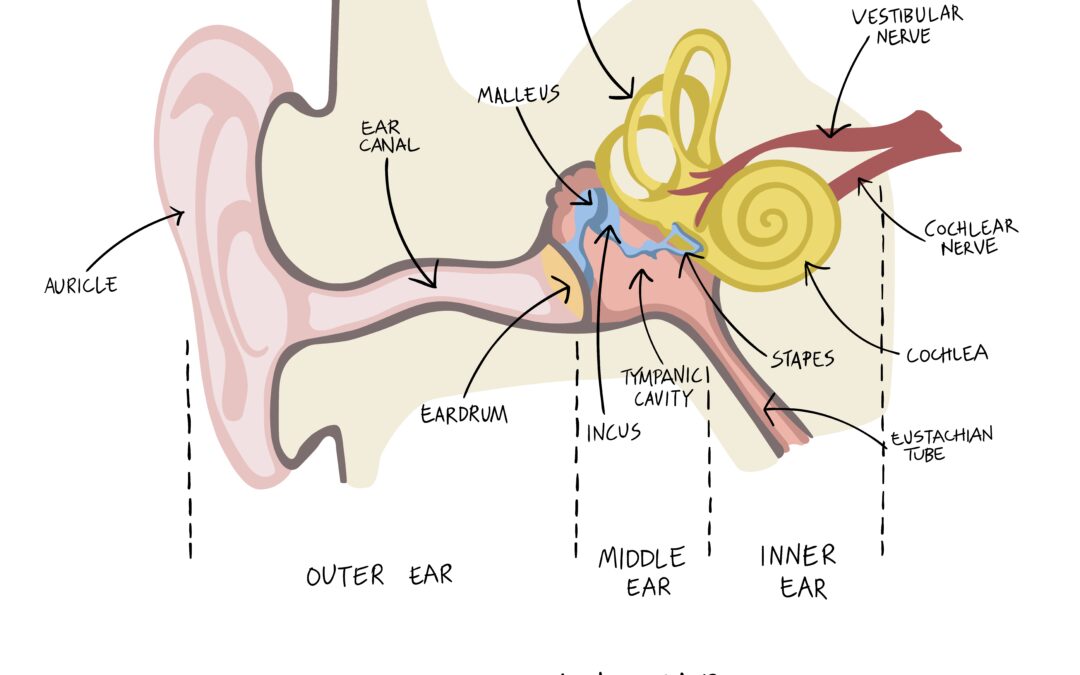
Have you ever spun around quickly and then felt like the room was still moving when you stopped? That sensation comes from your inner ear, or vestibular system, which plays a key role in balance and motion perception. When this system sends confusing signals, it can lead to spatial disorientation. Understanding the vestibular system and spatial disorientation helps explain why pilots lose control in clouds, why astronauts get sick in space, and why some people feel dizzy in everyday life. Most of us do not even think about the vestibular system or have heard of it until it is not working as it should.
What Is the Vestibular System?
The vestibular system is located in the inner ear. It includes semicircular canals that detect rotation and otolith organs that detect gravity and linear motion. Together, they send signals to your brain to keep you balanced and oriented.
What Is Spatial Disorientation?
Spatial disorientation happens when your brain can’t rely on accurate input from the vestibular system, especially when visual references are missing. This makes you feel like you’re moving or tilted when you’re not, or vice versa.
The Vestibular System and Spatial Disorientation in Everyday Life
You don’t need to be a pilot or astronaut to experience this. Motion sickness, dizziness when getting out of bed, or unsteadiness in the dark can all be linked to the vestibular system and spatial disorientation.
Aviation and the Vestibular System
In aviation, spatial disorientation is a leading cause of accidents. Without visual cues, a pilot may feel level while actually banking in a dangerous spiral. The vestibular system alone is not reliable enough for safe flight, which is why pilots must learn to trust their instruments.
Space Travel and Astronauts
Astronauts face unique vestibular challenges. In microgravity, the vestibular system doesn’t detect “up” or “down” correctly, leading to space motion sickness. This is a direct example of how spatial disorientation can affect even highly trained individuals.
When to Seek Help for Dizziness
For most of us, dizziness or spatial disorientation is most commonly due to a vestibular issue like motion sickness, BPPV, vestibular migraines, and inner ear infections, not banking a turn while in flight or working in a space station.
Regardless of the cause, if you live in Saskatchewan and are struggling with dizziness or spatial disorientation, you can book an appointment with one of our specially trained vestibular physiotherapists at North 49. Call 306-343-7776 or book online at www.north49therapy.com
References
Hadfield, C. (2013). An Astronaut’s Guide to Life on Earth. Random House.